Showing posts with label Nucleic Acids. Show all posts

Monday, 1 May 2017

Nucleic Acids: - Inorganic Ions

- Inorganic Ions -

Image result for inorganic moleculesInorganic ions are found in organisms in solution in the cytoplasm of cells and in body fluids, including parts of larger molecules.
They may be in areas that range from very high to very low concentration.
Functions of the ions can vary, however the specific function of a particular ion is based on the relation to it's properties.

Sunday, 30 April 2017

Nucleic Acids: - Water

- Water - 

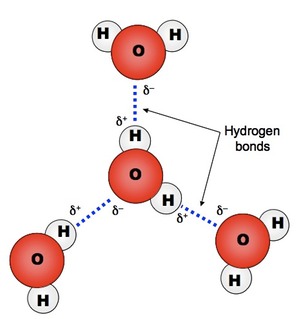
Dipolar water molecule: water is made up of two atoms of hydrogen and one of oxygen. The molecule has no overall charge although oxygen has a slightly negative charge and hydrogen has a slightly positive charge.
Water and hydrogen bonding:
A positive pole of one water molecule would attract the negative pole of another water molecule, the attraction force between the opposite charges is a hydrogen bond. Each bond is weak, however together they form important forces that cause water molecules to stick together, giving water unusual properties.

Image result for water structure
Specific heat capacity:

Water molecules stick together, it takes more energy -heat- to separate them then if they did not bond to one another. Resulting in the boiling point being high (100 degrees celsius)
Without hydrogen bonding water would be a gas at temperatures on earth.
Water acts as a buffer against sudden temperatures variations - aquatic environment is a temperature stable one.
Organisms are mostly water, protects them from sudden temperature change especially in terrestrial environment.
Latent heat of vaporisation of water:
Hydrogen bonding = lots of heat energy required to evaporate 1 gram of water. - latent heat of vaporisation.
Evaporation of water in mammals is therefore a very effective means of cooling, body heat is used to evaporate the water.
Cohesion and surface tension:
Tendency of molecules sticking together = cohesion
  • Hydrogen bonding = large cohesive forces, allowing it to be pulled through a tube - xylem vessel
  • Water molecules meet air, tend to be pulled back into the body of water than escaping from it = surface tension.
  • Water acts like a skin, strong enough to support small organisms - pond skaters

Importance of water to living organisms:
Water in metabolism -
  • Used to breakdown complex molecules - hydrolysis
  • Joins molecules together through the use of condensation reaction
  • Chemical reactions take place in aqueous medium
  • Water = major raw material in photosynthesis
Water as a solvent -
  • Readily dissolves other substances - gases ie, oxygen + carbon dioxide
  • Waste - ammonia + urea
  • Inorganic ions + small hydrophilic molecules - amino acids, monosaccharides, + ATP
  • Enzymes - reactions which takes place in a solution.

Important features of water:

  • Evaporation cools and allows organisms to control their temperature.
  • Not easily compressed = providing support - hydrostatic skeleton of animals// earthworm + turgor pressure in herbaceous plants
  • Transparent = aquatic plants can photosynthesise // light penetrate jelly like fluid that fills the eye and reach the retina.


Nucleic Acids: - ATP

- ATP - 


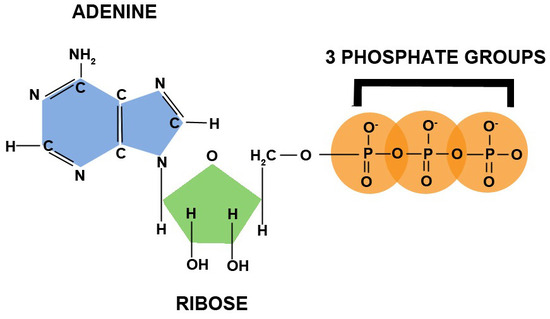
ATP - Adenosine triphosphate is a nucleotide and has three phosphate groups and is key in storing energy. The bonds between the phosphate groups are unstable therefore have a low activation energy - can be easily broken. They release a considerable amount of energy. In living cells it is only the terminal phosphate that is removed

Structure of ATP:
  • Adenine - nitrogen containing organic base.
  • Ribose - sugar molecule with 5 carbon ring structure - backbone
  • Phosphates - chain of three phosphate groups
.
Synthesis of ATP: ATP to ADP is a reversible reaction therefore energy can be used to add an inorganic phosphate to ADP to re-form ATP. This reaction is catalysed by enzyme ATP synthase. The reaction is a condensation reaction.

Image result for structure of ATP
The synthesis ATP from ADP involves addition of phosphate molecule to ADP.
  • In chlorophyll containing plant cells during photosynthesis (photophosphorylation)
  • In plant and animal cells during respiration (oxidative phosphorylation)
  • In plant and animal cells when phosphate groups are transferred from donor molecules to ADP (substrate level phosphorylation)
Roles of ATP:
  • ATP serves as an immediate energy source of a cell
  • Cells do not require large quantities of ATP
  • ATP is rapidly re-formed from ADP and inorganic phosphate
ATP is required as energy-requiring processes in cells:

  • Metabolic processes
  • Movement
  • Active transport
  • Secretion
  • Activation of molecules


Sunday, 23 April 2017

Nucleic Acids: - DNA Replicationn

- DNA Replication - 
DNA replication: cell division occurs in 2 main stages:
  • Nuclear division: nucleus divides
  • Cytokinesis - the whole cell divides
Semi-conservative replication ~ this ensures the genetic continuity between generations.

The enzyme DNA helicase breaks the hydrogen bonds between complementary bases in polynucleotides strands, causing the double helix to unwind/unravel.


.
The enzyme DNA polymerase joins adjacent nucleotide's in a condensation reaction.


The exposed nucleotide's act as a template to which the complementary free nucleotide's bid by specific base pairing


2 identical molecules of DNA are formed. This is due to each molecule retaining half of the original DNA materialWatson and Crick model of DNA replication suggested that the original DNA molecule splits into 2 separate strands therefore each of the new molecules would have one strand of the original material. This would be the semi-conservative model.  The conservative model suggests that the original molecule remained intact and the other molecule formed would be made of entirely new material

Image result for the conservative replication


Nucleic Acids: - Structure of RNA and DNA

- Structure of DNA and RNA -


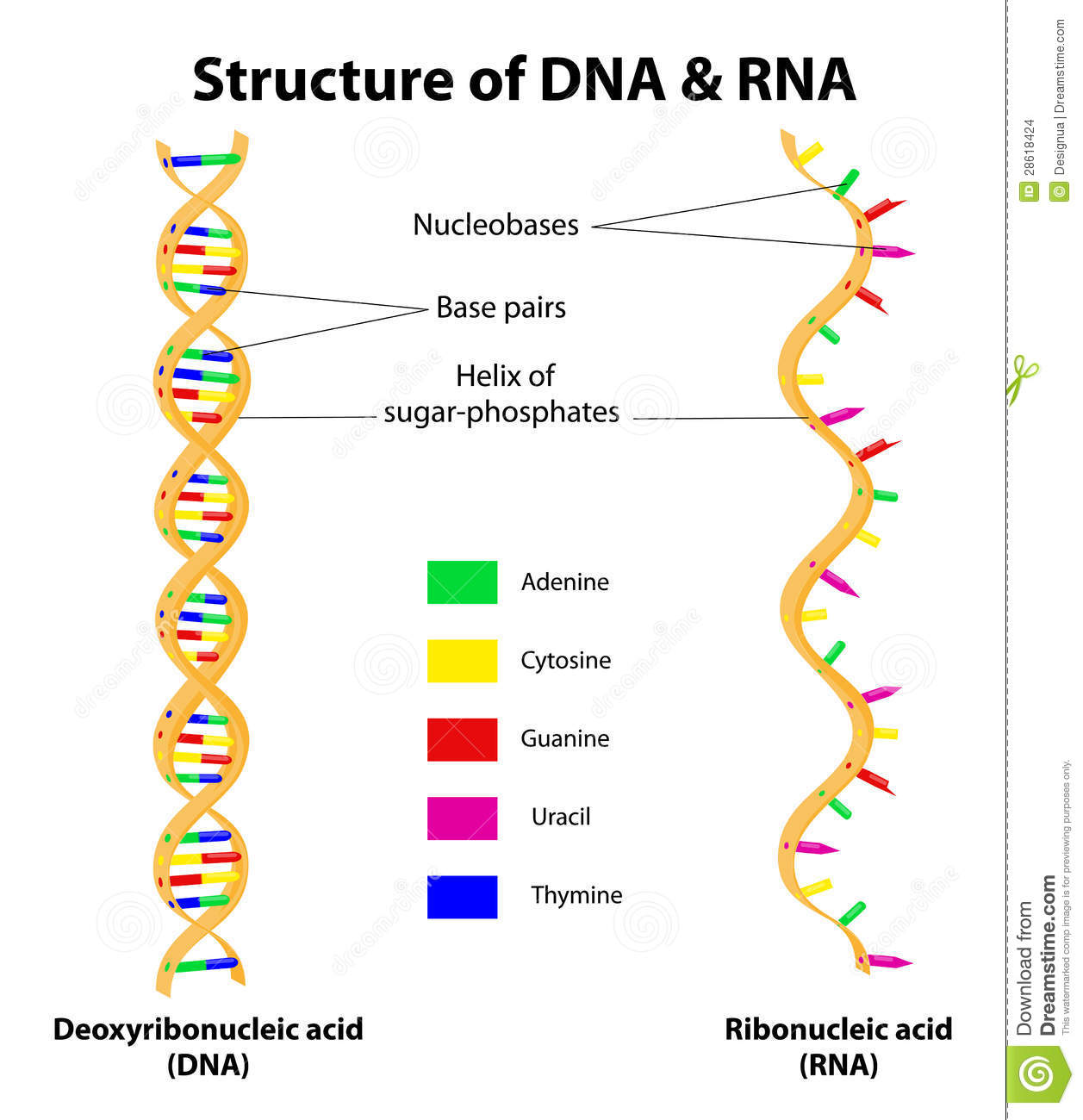
Deoxyribonucleic acid and ribonucleic acid are important information-carrying molecules. In all living cells, DNA holds genetic information and RNA transfers genetic information from DNA to the ribosomes.
DNA molecule is a double helix with two polynucleotides chains held together by hydrogen bonds between specific complementary base pairs.
  • Adenine is complementary to thymine
  • Guanine is complementary to cytosine
Ribosomes are formed from RNA and protein.
Both DNA and RNA are polymers of nucleotides. Each nucleotides is formed from

  • Pentose sugar
  • Phosphate group
  • Nitrogen-containing organic base

Nitrogen containing bases are:
  • Adenine - A
  • Thymine - T
  • Guanine - G
  • Cytosine - C
  • Uracil - U ( RNA molecules only // replaces Thymine (T))
Pentose sugar, phosphate group and organic base are joined as result of condensation reactions, forming a mononucleotide.
2 mononucleotides may in turn be joined by the condensation reaction between the deoxyribose sugar of one mononucleotide and the phosphate group of another. The bond formed between them is called a phosphodiester bond.
Image result for structure of rna and dna

RNA structure:
  • RNA molecules is a relatively short polynucleotide chain
  • The pentose sugar is ribose and the organic bases are adenine, guanine, cytosine, and uracil.
DNA structure // Double helix structure (DNA) ~
  • The pentose sugar is deoxyribose and the organic bases are adenine, thymine, guanine and cytosine.
  • Alternating phosphate and deoxyribose molecules make up the ‘uprights’ and pairs of organic bases comprise the ‘rungs’. The complementary base pairing ensures a standard ‘rung length’.

Stability of DNA ~
The phosphodiester backbone protects the more chemically reactive organic bases.
Hydrogen bonds link the organic base pairs forming bridges between the phosphodiester uprights
The higher the proportion of G-C pairings, with 3 hydrogen bonds, A-T pairings have 2 hydrogen bonds.
Function of DNA ~
-
DNA is responsible for passing genetic information from cell to cell.

- Adaptations.

- Large molecule - carries an immense amount of genetic information.

- Base pairing leads to DNA being able to replicate and transfer into as mRNA.

- The base pairs are found in the helical cylinders therefore they are protected from outside chemical and physical forces.

- Mutations in DNA due to the stability of the molecule. // whether or not a mutation would occur.

- Separate strands are held by hydrogen bonds - easy to separate.

- The simplicity of DNA led to many scientists doubt that it carried the genetic code.


Biological Molecules: - Carbohydrates

- Carbohydrates -   - Monosaccharides -  The monomer for carbohydrates is called monosaccharides.  Common for...